Rigid Container Bottling Architecture
Rigid PET, HDPE, glass, and tinplate lines depend on positive container control from empty infeed to case loading. Part of our automatic packaging lines range, rigid lines split into liquid filling, capping and labeling lines and powder jar and can seaming lines.
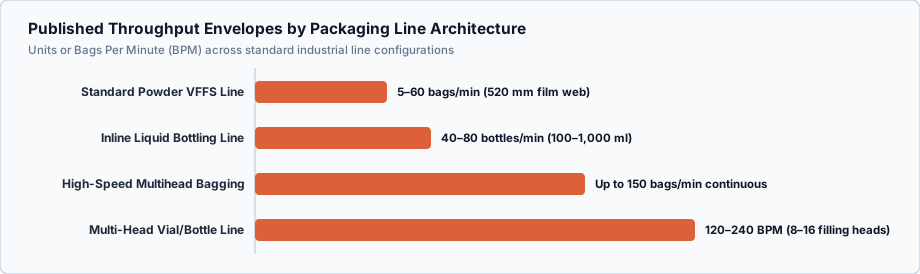
Standard inline gating fillers handle 40–80 bottles/min across 100–1,000 ml volumes (Ø 30–80 mm, height up to 250 mm), while multi-head inline and rotary monoblocks scale to 120–240 BPM.
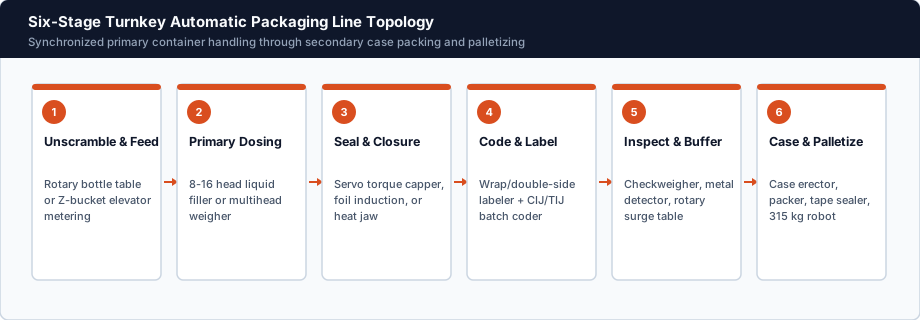
Station-by-Station Rigid Bottling Specifications
Each module along a rigid container line must match neck finish, fill viscosity, and closure torque:
| Line Station | Mechanism Options | Speed Envelope | Critical Specification |
|---|---|---|---|
| Unscrambler / Turntable | Centrifugal pocket sorter or rotary disc | 40–200 BPM | Scratch-free guide rails for clear PET |
| Rinsing / Air Ionizer | Inverted ionized air jet + vacuum | 40–200 BPM | Particulate removal before dry/liquid dosing |
| Primary Filler | Servo piston, overflow, gravity, or auger | 40–80 BPM (4-8H); 120–240 BPM (12-16H) | ±0.5%–1% dosing accuracy; diving nozzles |
| Capper & Sealer | Chuck servo torque or 4-wheel spindle + foil induction | 50–150 BPM | Consistent application & removal torque |
| Labeler & Coder | Wrap-around or double-side + CIJ/laser | 50–200 BPM | ±1 mm label registration on tapered/flat walls |
Compare straight inline versus rotary turret trade-offs in inline vs rotary packaging lines.
Critical Line Integration Checks
- Neck-Handling vs Body Guide Rails: Lightweight PET bottles benefit from neck-ring guides or quick-clamp change parts that cut format changeover under 20 minutes.
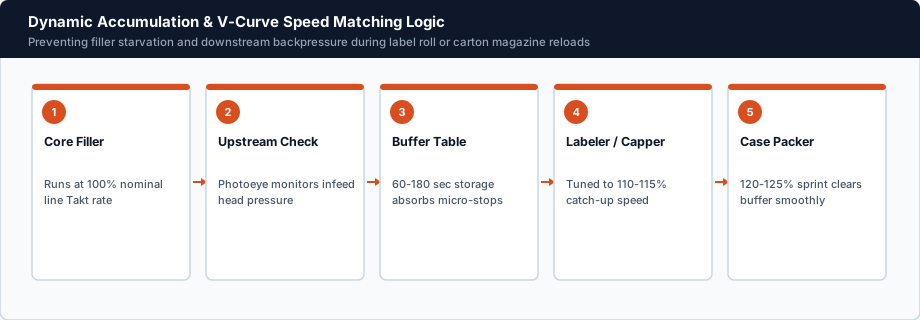
- Conveyor Drive Synchronization: A 10.4 m Delrin or stainless tabletop chain conveyor with VFD speed matching prevents bottle backpressure shingling.
- Reject Verification: Place inline checkweighing and cap-height/foil-presence sensors immediately before accumulation.
Sample Bottle Qualification
Test empty bottle stability at dry conveyor speeds 20% above target BPM, and measure cap thread pitch alongside induction liner diameter.
Send bottle drawings and fill volume targets via our Project Brief.
Explore related specifications in Automatic Packaging Lines, Line Configurations & Specs, and submit your container throughput targets via Project Brief.