Three Equations Size Every Synchronized Packaging Line
Sizing errors happen when buyers divide daily pack volume by 480 minutes and buy a filler with zero OEE margin or zero buffer storage between filler and labeler. Part of packaging line sizing and packaging line configurations, this reference gives you the exact sizing formulas used in line layout design.
Step 1 sets nominal filler speed: Nominal BPM = Shift Target Packs ÷ (Effective Shift Minutes × Target OEE). For 24,000 bottles in 450 net minutes at 0.78 OEE, Nominal BPM = 24,000 ÷ 351 = 68.4 BPM (specify a 75–80 BPM filler).
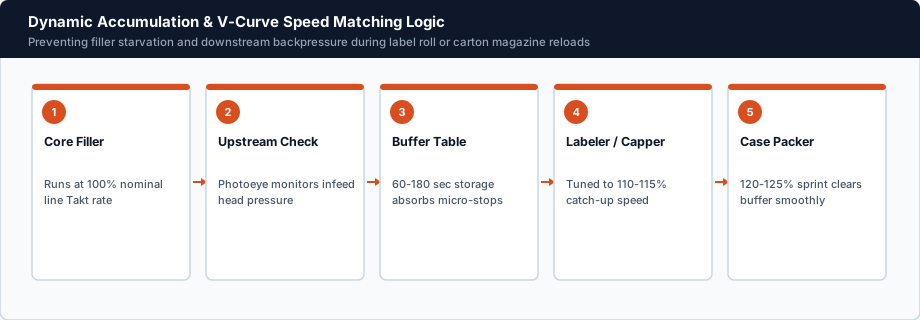
Worked V-Curve & Buffer Capacity Reference Table
Step 2 sets downstream catch-up speeds and rotary buffer capacity for a 90-second label splice stop:
| Nominal Filler Rate | Capper Rate (+10%) | Labeler Rate (+18%) | Case Packer (+25%) | 90-Sec Buffer Units | Buffer Drain Time (@ +18%) |
|---|---|---|---|---|---|
| 40 BPM (2,400 BPH) | 44 BPM | 47 BPM | 50 BPM | 60 containers | 8.6 min recovery |
| 60 BPM (3,600 BPH) | 66 BPM | 71 BPM | 75 BPM | 90 containers | 8.2 min recovery |
| 100 BPM (6,000 BPH) | 110 BPM | 118 BPM | 125 BPM | 150 containers | 8.3 min recovery |
| 150 BPM (9,000 BPH) | 165 BPM | 177 BPM | 188 BPM | 225 containers | 8.3 min recovery |
Pair speed sizing with power and air planning on our utility and footprint reference chart.
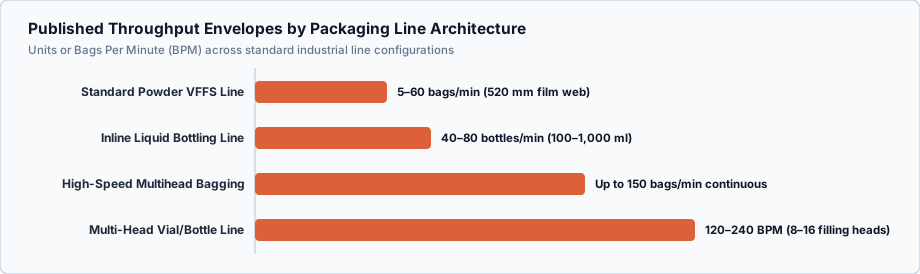
Critical Line Integration Checks
- Rotary Table Capacity Formula: Usable rotary disc storage (containers) ≈ 0.65 × (Disc Area ÷ Container Footprint Area); a Ø 1,200 mm table holds ~110–140 bottles of Ø 65 mm.
- Mass-Flow vs Single-File: Round containers accumulate cleanly on rotary or bi-directional tables; oval bottles and flexible pouches require FIFO serpentine or alpine conveyors.
- Avoid Over-Speed Instability: Tall narrow bottles with high centers of gravity tip if catch-up conveyor linear speed exceeds ~22–28 m/min.
Validate Your Numbers Against Real Container Dimensions
Send container diameter/width, shift schedule, and longest routine stop duration to confirm buffer diameter and conveyor lengths.
Share your figures via our Project Brief.
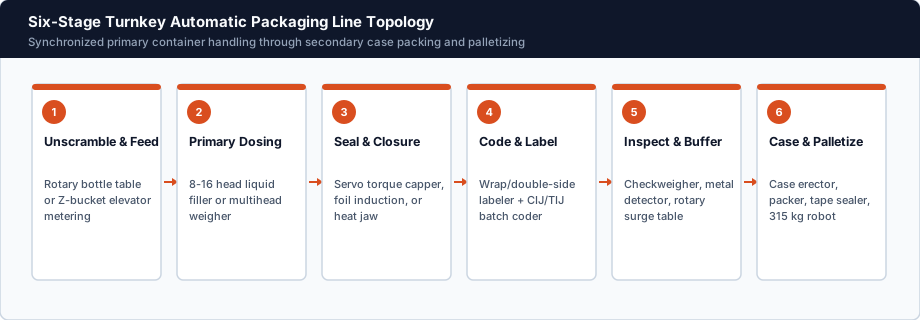
Explore related specifications in Automatic Packaging Lines, Line Configurations & Specs, and submit your container throughput targets via Project Brief.