Seven Sequential Decisions Eliminate Costly Mismatches
Choosing a line by watching a 15-second demo video on clean water or uniform plastic pellets is the fastest way to buy equipment that jams on real production batches. Part of packaging line sizing and packaging line configurations, follow these seven engineering steps in order.
Start by auditing every SKU you plan to run over the next 36 months—not just your hero SKU—because minimum/maximum container ratios bound the mechanical frame.
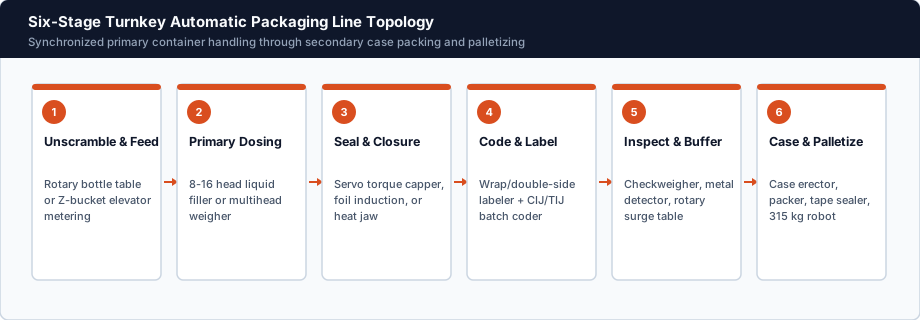
7-Step Packaging Line Selection Matrix
Work down this table before signing any equipment purchase order:
| Selection Step | Engineering Question | Data to Measure | Common Pitfall to Avoid |
|---|---|---|---|
| 1. Product Audit | How does the product flow, bridge, foam, or stick? | Viscosity (cP), bulk density, piece fragility, fill temp | Testing water instead of cold viscous syrup |
| 2. Container Range | What is the min-to-max container envelope? | Ø/W/H drawings, neck finish, laminate film structure | Exceeding 3:1 size ratio on one frame |
| 3. OEE Speed Sizing | What nominal BPM hits shift volume at 78% OEE? | Net shift minutes, changeover count, target BPM | Sizing filler at 100% peak with zero headroom |
| 4. Buffer & V-Curve | Where will 60–90 sec micro-stops accumulate? | Label roll swap time, rotary buffer disc capacity | Hard-coupling filler directly to case packer |
| 5. Floor & Utilities | Does the line fit bay L×W×H, power, and dry air? | Column map, ceiling height, kW, m³/min @ 0.8 MPa | Forgetting Z-elevator overhead clearance |
| 6. Changeover Design | How fast can operators swap SKUs repeatably? | Digital counters, HMI recipes, tool-free rails | Requiring wrenches at 20 undocumented points |
| 7. Full-Line Wet FAT | Will the whole line run real product pre-shipment? | 30–60 min continuous FAT run + accuracy Cpk | Accepting dry-cycle-only standalone tests |
Download or apply the full acceptance protocol on our turnkey packaging line FAT checklist.
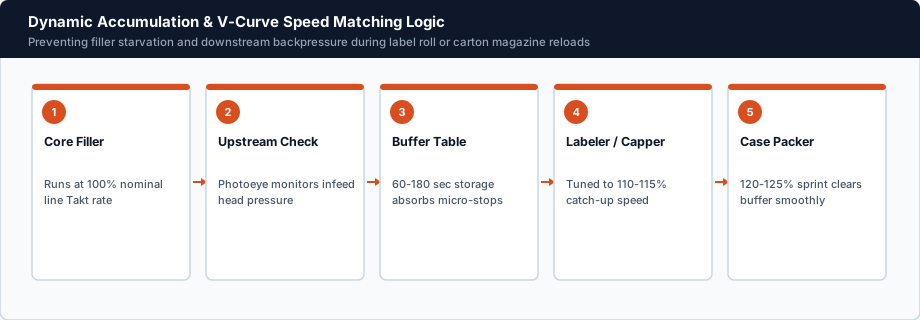
Critical Line Integration Checks
- Standardize Closure & Film Specs Early: Minor variations in corrugated board flute stiffness or pouch zipper thickness cause 80% of chronic feeding faults; lock packaging material tolerances with your converters.
- Demand Fault-Cascade Logic: Verify that a downstream photoeye block pauses infeed gating cleanly without leaving open containers under hot induction coils.
- Check Local Serviceability: Confirm standard commercial bearings, belts, pneumatic cylinders, and unlocked PLC diagnostics.
Turn Your Answers Into a Clean RFQ
Even partial answers to Steps 1–5 are enough for an initial layout and speed check.
Submit your SKU list and floor dimensions via our Project Brief.
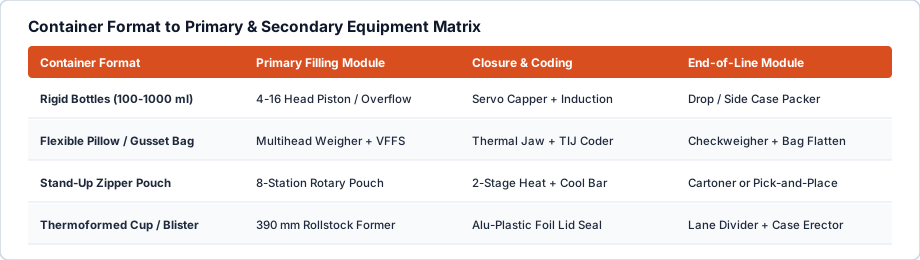
Explore related specifications in Automatic Packaging Lines, Line Configurations & Specs, and submit your container throughput targets via Project Brief.