Matching Liquid Rheology to Filler & Closure Stations
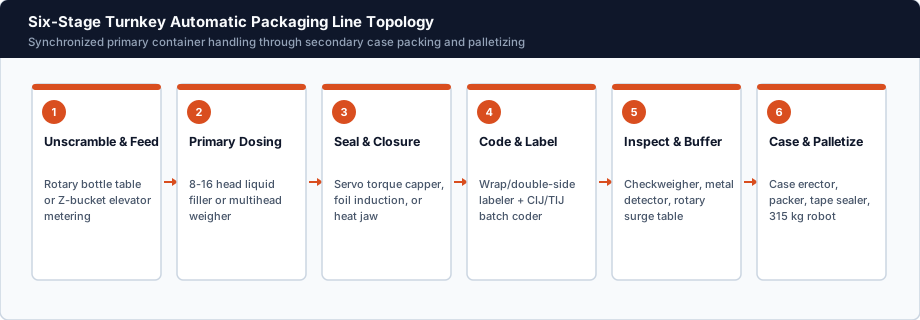
Liquid rheology—water-thin beverages, foaming detergents, or viscous edible oils and syrups—sets the metering principle at the heart of bottle packaging lines. Within our automatic packaging lines portfolio, coordinated liquid lines eliminate drip contamination on bottle threads so caps torque cleanly and labels adhere dry.
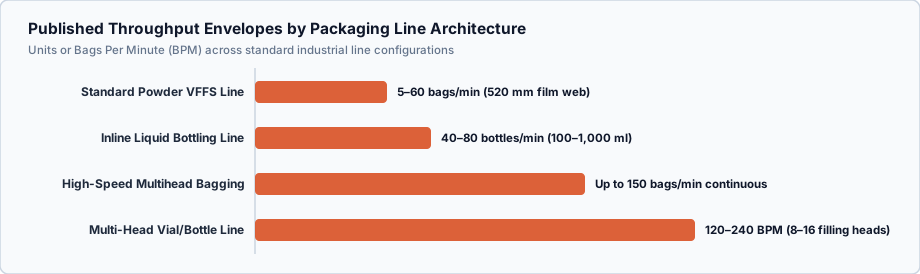
Standard 4-to-8 head inline servo piston or overflow fillers handle 40–80 BPM across 100–1,000 ml bottles, while 12-to-16 head inline or rotary monoblocks scale to 120–200+ BPM.
Liquid Metering Architecture Selection Table
Choose the primary filling head technology according to viscosity, particulates, and cosmetic fill-level requirements:
| Metering Technology | Viscosity & Product Fit | Accuracy / Control | Speed (8-Head Frame) | Key Anti-Drip Feature |
|---|---|---|---|---|
| Overflow Level Filler | Free-flowing clear liquids, foamy cleaners, beverages | Uniform cosmetic meniscus level | 50–90 BPM | Recirculation return manifold + foam seal |
| Servo Volumetric Piston | Oils, lotions, sauces, gels, creams (up to 50,000 cP) | ±0.5% volumetric repeatability | 40–80 BPM | Bottom-up diving + pneumatic positive shutoff |
| Peristaltic / Time-Gravity | Sterile vials, reagents, corrosive thin liquids | ±0.5%–1.0%; quick tubing swap | 30–120 BPM | Zero cross-batch valve contact |
| Net-Weight Load Cell | High-value oils, 1 L–5 L jugs with density drift | ±1–2 g gravimetric cutoff | 20–50 BPM | Two-stage bulk + dribble valve |
Compare dry container setups on powder jar and can seaming lines.
Critical Line Integration Checks
- Thread Hygiene & Induction Integrity: Any product droplet on the bottle land causes induction foil burn-through or micro-leaks; use diving nozzles with suck-back valves.
- Wet vs Dry Labeling Sequence: Rinse and air-knife dry external bottle walls whenever hot-fill or foaming overflow precedes pressure-sensitive labeling.
- Torque & Liner Inspection: Pair servo chuck cappers with high-cap optical sensors and missing-foil detectors prior to case packing.
Liquid Sample & Closure Testing
Provide product filling temperature, viscosity (cP), foaming behavior, and cap/liner style (screw, flip-top, trigger pump, ROPP).
Request a synchronized bottling layout via our Project Brief.
Explore related specifications in Automatic Packaging Lines, Line Configurations & Specs, and submit your container throughput targets via Project Brief.