Finding the True Speed and SKU Crossover Point
One of the earliest capital decisions in industry packaging lines and packaging line configurations is choosing between linear intermittent/continuous motion and rotary turret handling. Inline machines index containers along a straight conveyor without dedicated starwheels, whereas rotary monoblocks carry each container in precision turret pockets through continuous motion.
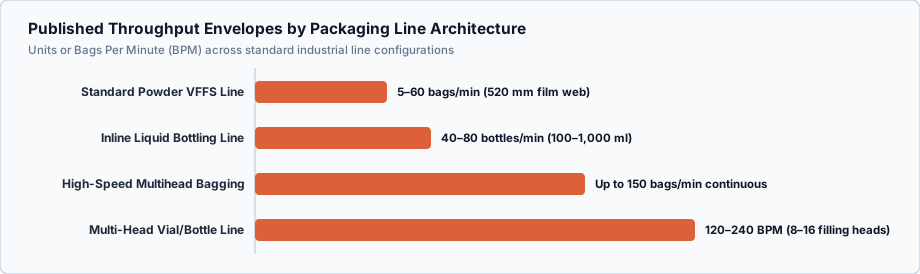
Below 80–100 BPM with frequent container shape changes, inline architectures dominate on ROI and changeover simplicity; above 120–150 BPM on long dedicated runs, rotary turrets win on compact footprint and smooth centrifugal handling.
Head-to-Head Engineering Comparison: Inline vs Rotary
Evaluate both architectures across five operational dimensions before locking capex:
| Criterion | Automatic Inline Line | Rotary Turret / Monoblock Line | Practical Buyer Rule |
|---|---|---|---|
| Economic Speed Band | 30–100 BPM (4 to 12 inline heads) | 120–300+ BPM (12 to 32 rotary stations) | Crossover typically sits at 100–120 BPM |
| Format Changeover | 15–25 min via rail, nozzle & HMI adjustment | 30–60 min swapping starwheels, guides & feed screws | High-SKU plants (>3 swaps/week) favor inline |
| Change-Part Cost per SKU | Minimal (universal side belts & gating cylinders) | $2,500–$8,000+ per custom bottle geometry set | Factor future bottle redesigns into 5-year TCO |
| Station Footprint | Longer straight run, narrow width | Compact square monoblock footprint | Rotary saves linear bay length at high BPH |
| Unstable Container Control | Requires puck handling for vials/tapered shapes | Positive pocket capture from infeed to capper | Small unstable glass vials often favor rotary/pucks |
See budget impacts across both architectures in automatic packaging line cost.
Critical Line Integration Checks
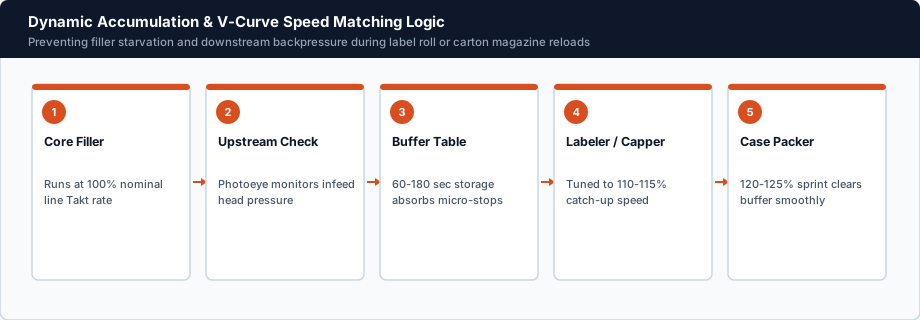
- Hybrid Inline-Plus-Rotary Lines: Many 80–120 BPM plants pair a 12-head servo inline filler with a rotary chuck capper to combine zero-change-part filling with positive high-torque capping.
- Puck-Handling Alternative: When cosmetics lines run 10+ unstable bottle shapes at 50–70 BPM, standardized carrier pucks let a single inline rail setting handle every SKU.
- Maintenance Accessibility: Inline stations offer open walk-up access to every nozzle and cylinder without rotating turret slip-rings or cam followers.
Match Architecture to Your SKU Mix
Count how many distinct container footprints you run per week alongside your peak single-SKU run length.
Share your SKU matrix via our Project Brief.
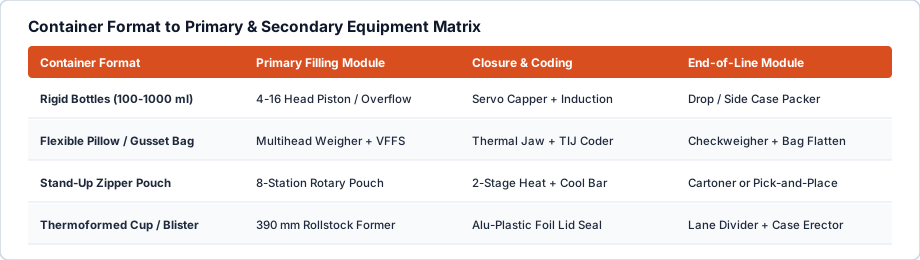
Explore related specifications in Automatic Packaging Lines, Line Configurations & Specs, and submit your container throughput targets via Project Brief.