What Drives Total Turnkey Line Investment
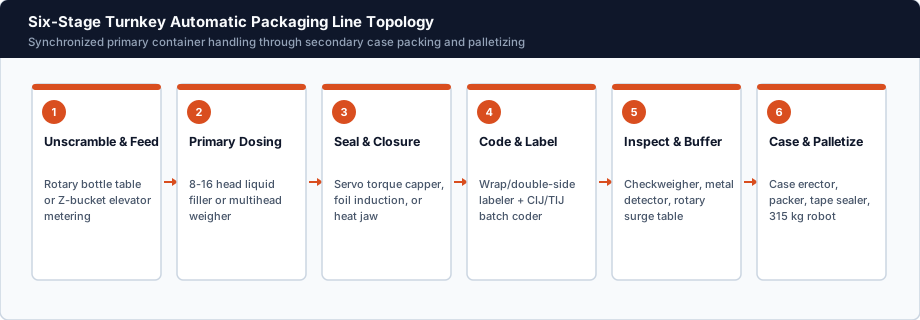
Comparing headline quotes without checking station scope leads to 30%–40% budget gaps once conveyors, coding, inspection, and air systems are added. Within packaging line sizing and packaging line configurations, a transparent cost breakdown separates primary dosing hardware from secondary end-of-line automation and plant utilities.
Moving from manual/semi-automatic stations (1 dedicated operator per station) to a synchronized automatic line typically cuts direct line staffing to 1–2 technicians while reducing product giveaway from 3%–5% down to <0.5%.
Cost Allocation Share Across a Turnkey Line
On a complete primary-to-case-pack installation, capital distributes predictably across five buckets:
| Budget Bucket | Typical Share of Capex | Included Scope | Primary Cost Multiplier |
|---|---|---|---|
| Primary Dosing & Sealing | 35%–45% | Multihead weigher + VFFS, or 8–16H filler + capper + induction | Head count, SUS316L metallurgy, washdown IP65+ |
| Infeed, Conveyors & Buffers | 12%–18% | Unscrambler/Z-elevator, tabletop conveyors, rotary surge tables | Accumulation minutes & stainless sanitary frames |
| Labeling, Coding & CCP | 15%–20% | Wrap/double-side labeler, CIJ/TIJ/TTO coder, checkweigher + metal | Vision OCR serialization or X-ray inspection |
| Secondary Case / Palletizing | 18%–28% | Case erector, drop/pick-place packer, sealer, 315 kg robot cell | Automatic case packing vs manual hand-pack table |
| FAT, Spares & Freight | 5%–10% | 2-year wear kit, extra SKU change parts, sea crating | Number of distinct container format sets |
Use our buyer selection guide to phase primary and secondary capex smartly.
Critical Line Integration Checks
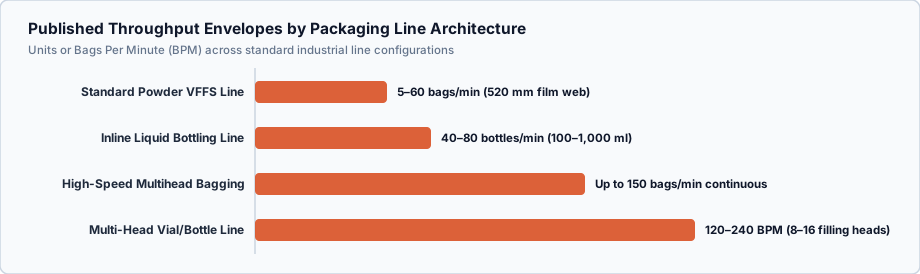
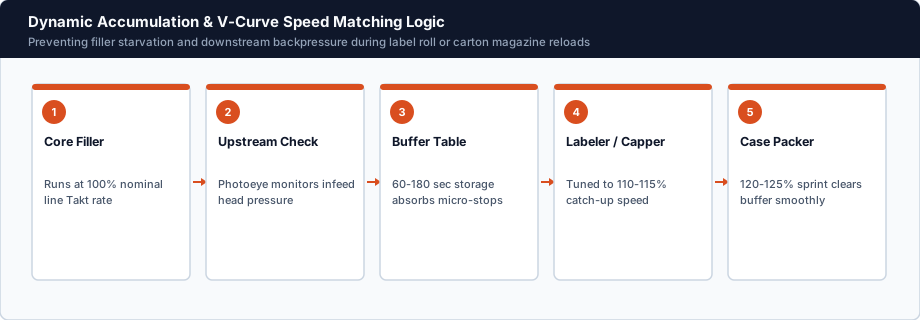
- Phased Automation Option: Plants with tight year-one budgets often automate unscrambling through checkweighing first, discharging onto a rotary pack-off table sized for year-two case-packer bolt-on.
- Giveaway Payback Math: Saving 2 g of overfill per pack at 60 BPM across two shifts recovers ~14,400 kg of product annually—often funding precision servo/multihead dosing in 12–18 months.
- Hidden Utility Costs: Verify whether your existing air compressor and electrical panel cover the 0.8 MPa air and kW demand before installation.
Request an Itemized Station-by-Station Quote
Insist on itemized station pricing so optional end-of-line modules and extra SKU change parts can be evaluated clearly.
Send your target BPM and container specs via our Project Brief.
Explore related specifications in Automatic Packaging Lines, Line Configurations & Specs, and submit your container throughput targets via Project Brief.