Sizing Around Effective OEE Rather Than Nameplate Peak
A line rated at 60 BPM nameplate rarely delivers 3,600 packs every clock hour once film splices, label roll swaps, sanitation, and SKU changeovers are deducted. As part of packaging line configurations, this hub connects our line speed and accumulation calculator, utility and footprint reference chart, automatic packaging line cost breakdown, buyer selection guide, and turnkey FAT checklist.
Size the core primary filler so your required shift output is achieved at 75%–82% OEE, leaving 18%–25% headroom for real-world stops.
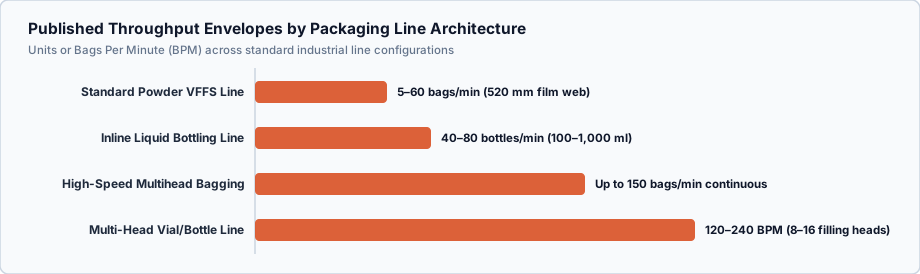
Shift Target to Nominal Machine Rating Table
Use realistic OEE planning factors (75% for multi-SKU lines, 82% for dedicated single-SKU runs) to pick the right line tier:
| Shift Output (8h Net) | Effective Rate Needed | Recommended Filler Rating (@78% OEE) | Recommended Downstream Capper/Labeler | Typical Line Class |
|---|---|---|---|---|
| 15,000 packs / shift | 31.3 packs/min | 40–45 BPM nominal | 50 BPM (+15%) | 4–6 Head Inline / Single VFFS |
| 28,000 packs / shift | 58.3 packs/min | 75 BPM nominal | 85–90 BPM (+15%) | 8-Head Bottling / 14-Head VFFS |
| 45,000 packs / shift | 93.8 packs/min | 120 BPM nominal | 135–145 BPM (+18%) | 12–16 Head / Continuous VFFS |
| 75,000 packs / shift | 156.3 packs/min | 200 BPM nominal | 230+ BPM (+15%) | Rotary Monoblock + Robotic End-of-Line |
Check floor power and compressed air sizing on the utility and footprint reference chart.
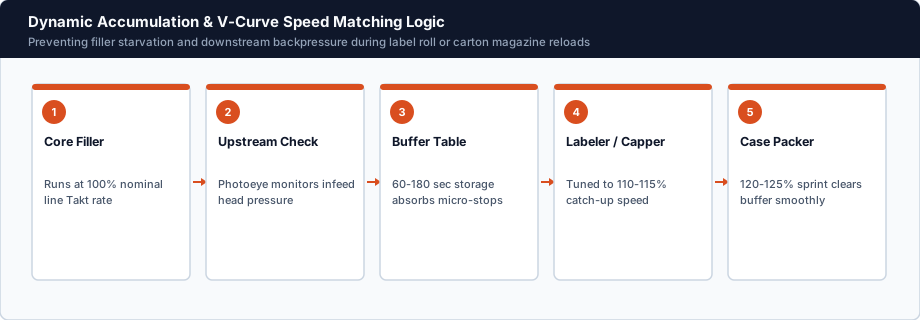
Critical Line Integration Checks
- Accumulation Time Budget: Measure your longest routine micro-stop (typically 45–90 seconds for a label web splice) and size rotary or serpentine buffer capacity to hold that volume.
- Changeover Frequency Impact: Four 30-minute SKU changeovers consume 25% of an 8-hour shift; tool-less quick-release starwheels pay back rapidly in high-mix plants.
- Compressed Air Headroom: Add a 25% safety margin above published air consumption (e.g., 1.5 m³/min supply for a 1.2 m³/min @ 0.8 MPa bottling line) to prevent pressure droop.
Locking Your Sizing Brief
List your smallest and largest container dimensions, fill weights, and weekly SKU schedule before requesting quotes.
Submit your shift targets via our Project Brief.
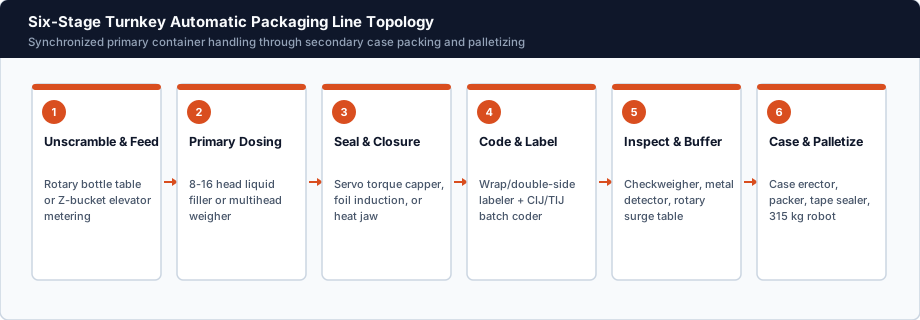
Explore related specifications in Automatic Packaging Lines, Line Configurations & Specs, and submit your container throughput targets via Project Brief.
In This Section
- Packaging Line Speed (BPM) & Accumulation Buffer Sizing Guide
- Packaging Line Floor Footprint, Electrical & Compressed Air Reference Chart
- Automatic Packaging Line Cost Breakdown & Payback Drivers
- How to Choose an Automatic Packaging Line Without Bottlenecks
- Turnkey Packaging Line RFQ & Factory Acceptance Test (FAT) Checklist
Related Specifications
Further Reference
- Packaging Line Configurations, Floor Layouts & Speed Synchronization
- Packaging Line Speed (BPM) & Accumulation Buffer Sizing Guide
- Packaging Line Floor Footprint, Electrical & Compressed Air Reference Chart
- Automatic Packaging Line Cost Breakdown & Payback Drivers
- How to Choose an Automatic Packaging Line Without Bottlenecks