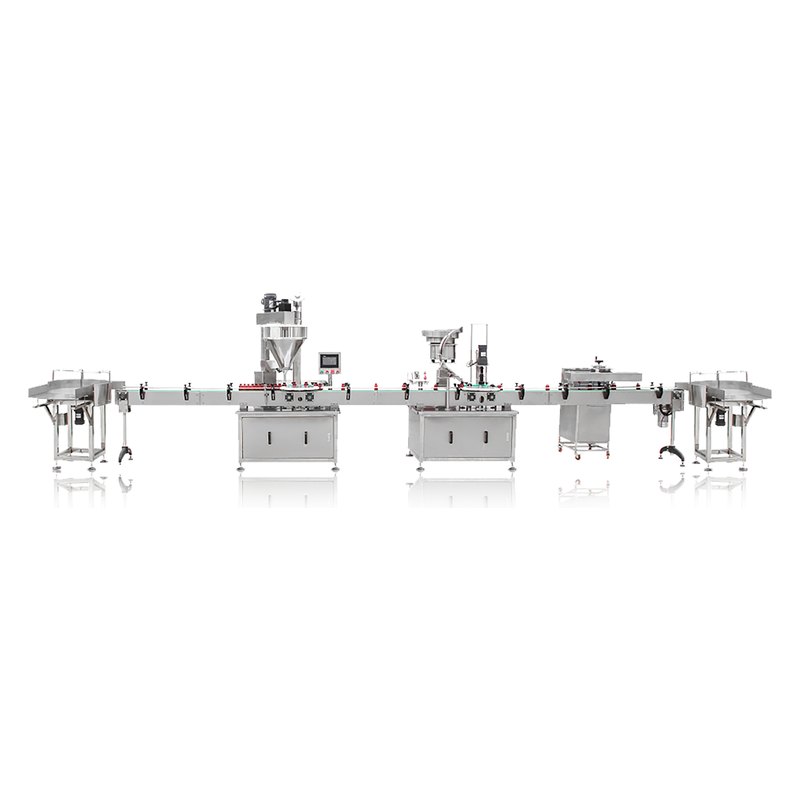
What It Is Built For vs. When to Choose Another Configuration
Use this rapid application screen to confirm whether Bottle Filling, Capping & Labeling Line matches your container geometry, product flow behavior, and target throughput before freezing specifications.
Use It For
- Rigid PET, HDPE, PP, or glass jars and bottles filled with dense pastes, powders, granules, or viscous blends.
- Plants replacing manual table-top filling and hand-capping with one synchronized conveyor spine from empty-bottle unscrambling to finished labeling.
- Containers requiring consistent screw-cap application torque and optional induction aluminum-foil hermetic liner sealing.
- Co-packing lines running cylindrical jars where rotary unscrambling and collecting turntables minimize operator headcount.
When to Choose Another Configuration
- You are dosing small honey or functional liquid shots into beverage cap cavities and spoon closures rather than full bottles.
→ Switch to Cap-Cavity Honey Filling & Foil Sealing Line - Your rigid container is a tinplate, aluminum, or composite can requiring mechanical double-seaming under vacuum.
→ Switch to LV-135ZFG Automatic Vacuum Can Seamer - You are switching from rigid jars to lightweight resealable stand-up zipper pouches.
→ Switch to LV-210 Rotary Premade Pouch Line
Technical Specifications & Operating Conditions
This multi-station or format-specific LINEVO configuration (hookah-filling-line) is dimensioned directly from your physical product sample, container/carton drawings, and production room layout.
| Configuration Parameter | LINEVO Architecture | Project Verification Condition |
|---|---|---|
| LINEVO Equipment Family | T06 / T11 Synchronized Rigid Bottle & Jar Packaging Line | Configured around actual bottle, cap, and label drawings. |
| Standard 5-Machine Spine | Unscrambler → Indexing Belt → Auger Filler → Screw Capper → Labeler | Foil sealer and rotary collecting table added per layout. |
| Container Compatibility | Round and shaped rigid plastic/glass jars & bottles | Guide rails and starwheels machined to sample containers. |
| Acceptance Testing | Wet/product trial on client jars, closures, and label rolls | Torque, fill weight, and label registration verified in Foshan. |
What Is Included vs. What We Review Per Project
Clear scope boundaries prevent startup surprises between the base machine and project-specific dosing, tooling, and plant interfaces:
Included in Core Machine Scope
- Automatic bottle unscrambler feeding upright empty containers onto the line
- Synchronized indexing conveyor positioning containers accurately under the dosing nozzle
- Auger filling station metering product to a preset value
- Automatic screw capping machine and inline bottle labeling machine
Reviewed & Specified With Your Quotation
- Aluminum foil induction/conduction sealing unit and finished-bottle rotary collecting/sorting table
- Auger screw vs. piston/overflow dosing head selection when running free-flowing liquids vs. pastes/powders
- Starwheel/guide change parts per bottle diameter, cap feeder bowl tooling, and label orientation sensors
Working Sequence & Shop-Floor Countermeasures
Step-by-Step Operating Cycle
- STEP 01Empty bottles loaded into the rotary unscrambler are oriented upright and metered single-file onto the stainless indexing conveyor.
- STEP 02The indexing stop holds each container beneath the auger filler nozzle until the preset fill charge is dispensed cleanly.
- STEP 03Filled jars advance into the screw capping station where closures are fed, placed, and tightened to repeatable torque.
- STEP 04Containers pass through optional aluminum-foil liner sealing and into the inline labeler before accumulating on the finished-bottle sorting table.
Real Production Floor Failure Modes & LINEVO Countermeasures
Countermeasure: Preset servo auger metering maintains repeatable screw revolutions per container, verified on your exact paste or powder during Foshan trials.
Countermeasure: Dedicated cap-placement alignment and screw capping station prepare flat, properly torqued closures ahead of optional aluminum-foil sealing.
Countermeasure: Continuous synchronized indexing conveyor with matched guide-rail transitions carries containers smoothly from unscrambler to collecting table.
Countermeasure: Inline labeling station matched to container geometry applies labels smoothly after capping so jar walls remain clean and rigid.
Comparing Quotations? Check These 5 Things First
5-Point Buyer Quotation Audit
- Speed Test Conditions vs. Shift OEE: Confirm whether quoted bags/boxes per minute reflect dry-cycle empty-film speed or filled product at your exact target weight, and plan net shift output using a realistic 0.70–0.85 OEE factor.
- Dosing & Upstream/Downstream Handshake: Verify mechanical chute/conveyor transitions and PLC ready/interlock signals between scales, primary sealers, cartoners, and checkweighers.
- Utility Power & Clean Dry Air Split: Match electrical panel build to your exact factory voltage, phase, and frequency (e.g., 220 V single-phase vs. 380 V/480 V 3-phase, 50/60 Hz) and confirm regulated oil-free dry air MPa and m³/min.
- Format Tooling for Extra Pack Sizes: Identify which pack dimensions adjust via HMI/handwheels versus which require dedicated forming collars, rotary discs, sealing chucks, or carton molds.
- Pre-Shipment Sample & Film FAT Run: Ensure the contract specifies a Foshan Factory Acceptance Test running your physical product samples and printed laminate reels or cartons before balance shipment.
Pre-Dispatch Foshan FAT & Project Sequence
Bench check of your product flow, piece geometry, and film/carton tolerances in Foshan.
Signed station list, utility schedule, format tooling table, and 2D CAD floor layout.
In-house CNC machining, SUS304/316L fabrication, and PLC electrical assembly.
Live or multi-angle video acceptance run on your actual packaging material before crating.
Sea-worthy export cases, bilingual HMI recipes, spare wear kit, and remote/on-site commissioning.
Control Cabinet & Pneumatic Hardware BOM
Main programmable logic controller coordinating dosing, film/pouch indexing, and sealing interlocks.
Phase-angle timing feedback, cabinet switching relays, and regulated 24V DC power supply.
Multi-recipe color operator terminal and inverter motor speed control for main drives and conveyors.
Actuation cylinders, pneumatic manifold valves, vacuum manometer, and air preparation unit.
Representative electrical, sensing, and pneumatic hardware fitted on LINEVO packaging configurations; exact part series or project-specified alternatives are itemized in your written quotation BOM.
Frequently Asked Questions
Can this bottle line be configured with piston dosing instead of auger dosing for liquid sauces or oils?
Yes. While the catalog configuration uses an auger filler for pastes, powders, and dense blends, LINEVO configures T06 rigid bottling spines with servo piston or overflow liquid heads when your viscosity test calls for liquid metering.
Is aluminum-foil liner sealing included or reviewed separately?
Aluminum-foil sealing and finished-bottle rotary sorting tables are optional layout modules reviewed with your closure drawing so liner diameter, cap material, and conveyor clearance match.
How many operators are needed to run the five-station bottle line?
Typically one operator replenishes empty bottles, caps, and label rolls while monitoring fill weights, compared with four to five manual stations on unlinked benchtop machines.