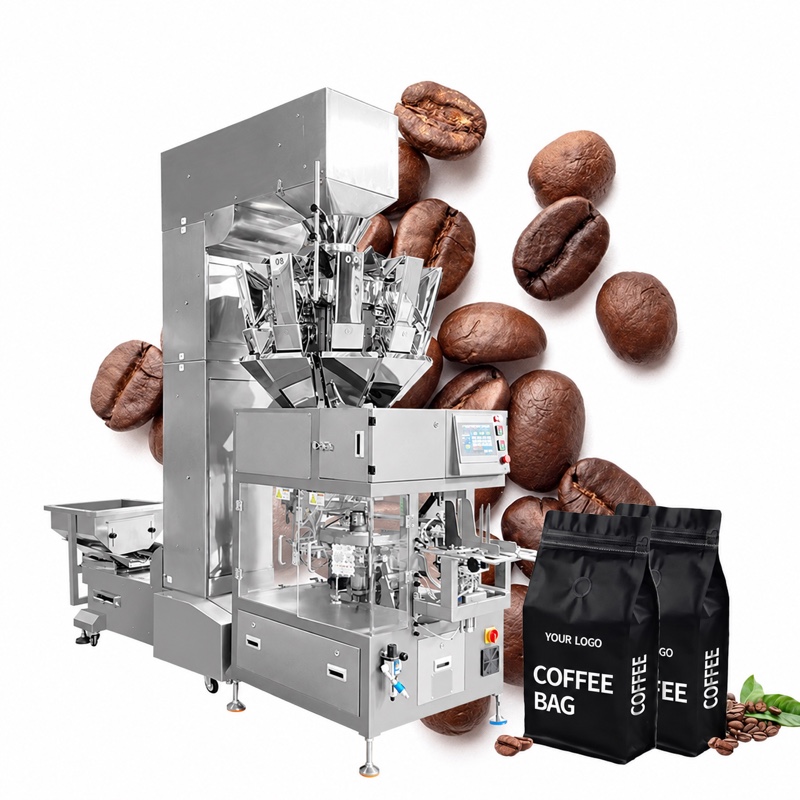
What It Is Built For vs. When to Choose Another Configuration
Use this rapid application screen to confirm whether LV-210 Premade Pouch Line matches your container geometry, product flow behavior, and target throughput before freezing specifications.
Use It For
- Whole-bean coffee, specialty snacks, pet treats, dried foods, and granular products requiring retail stand-up zipper doypacks or shaped pouches.
- Multi-SKU co-packing lines switching frequently across 90–210 mm (3.54–8.27 in) pouch widths without buying VFFS forming collars.
- Low-ceiling packaging rooms where the 1,300 mm (51.2 in) machine height provides full waist-level operator visibility across every station.
- Turnkey pouch-to-carton lines feeding finished doypacks into downstream checkweighers, cartoners, or case packers.
When to Choose Another Configuration
- Lowest packaging film cost per thousand bags matters more than pre-made zipper stand-up presentation.
→ Switch to Multihead Weigher VFFS Line (Rollstock) - You need pouches automatically loaded into folding cartons and wrapped in transparent 3D film on one continuous spine.
→ Switch to Straight-Line Pouch, Cartoning & Cellophane Line - Your product is a 1–30 g single-serve powder stick rather than a 90–210 mm wide retail pouch.
→ Switch to LV-400BF / 680BF / 980BF Stick Pack Machine
Technical Specifications & Operating Conditions
Every value below is grounded in LINEVO's factory catalog for ds-210 (LV-210), paired with exact arithmetic imperial conversions where millimeter, gram, kilogram, or liter units apply.
| Parameter | Metric Value | Imperial Equivalent | Operating Condition & Engineering Note |
|---|---|---|---|
| Pouch width | 90–210 mm | 3.54–8.27 in | The forming set or change parts are made for each pack size you run. |
| Pouch length | 110–330 mm | 4.33–12.99 in | The forming set or change parts are made for each pack size you run. |
| Listed packing speed | 20–70 bags/min | — | Output depends on the intended pouch and product; establish the production target with representative trials. |
| Listed power | 3.5 kW | — | Give the voltage, phase and frequency at your site; the quotation states the electrical configuration. |
| Listed supply | 220 V, 50/60 Hz | — | Give the voltage, phase and frequency at your site; the quotation states the electrical configuration. |
| Listed dimensions | 2150 × 1350 × 1300 mm | 84.6 × 53.1 × 51.2 in | Machine dimensions; review the complete line layout and access space. |
What Is Included vs. What We Review Per Project
Clear scope boundaries prevent startup surprises between the base machine and project-specific dosing, tooling, and plant interfaces:
Included in Core Machine Scope
- LV-210 base machine with automatic premade pouch magazine retrieval, vacuum mouth/zipper opening, and heat-sealing stations
- 3.5 kW drive and heating control cabinet (listed at 220 V, 50/60 Hz; site voltage/phase confirmed in quotation)
- Finished-pouch discharge chute within the 2150 × 1350 × 1300 mm machine footprint
Reviewed & Specified With Your Quotation
- Upstream weighing and filling arrangement (multihead combination scale, auger filler, or volumetric dosing matched to your solid/powder)
- Dedicated zipper-opening jaws, bottom-gusset spreading, and product funnel change parts per pouch size
- Date coding, Z-elevator/platform feeding, nitrogen flushing, and downstream checkweighing
Working Sequence & Shop-Floor Countermeasures
Step-by-Step Operating Cycle
- STEP 01Pre-stacked stand-up or flat pouches (W 90–210 × L 110–330 mm) are retrieved automatically one by one from the horizontal magazine.
- STEP 02Vacuum suction pads and mechanical opening fingers separate both top pouch lips and unlock the press-to-close zipper track.
- STEP 03Synchronized overhead weighing or auger dosing discharges the measured charge through a dust-shielded funnel into the open pouch.
- STEP 04Top heat-sealing bars weld a smooth, wrinkle-free hermetic seam above the tear notch and discharge the finished pack.
Real Production Floor Failure Modes & LINEVO Countermeasures
Countermeasure: Dedicated vacuum retrieval and mechanical zipper-opening sequence separates both top lips and the inner zipper profile before enabling the filler dump signal.
Countermeasure: Pouch-width gripping and format guides adjust cleanly across the 90–210 mm envelope so pouches hang square entering the heat-seal jaws.
Countermeasure: Matched filling funnel geometry shields the upper seal and zipper zone while product settles into the bottom gusset.
Countermeasure: The LV-210 base frame stands just 1,300 mm tall (2150 × 1350 × 1300 mm), allowing compact low-headroom weigher integration.
Comparing Quotations? Check These 5 Things First
5-Point Buyer Quotation Audit
- Speed Test Conditions vs. Shift OEE: Confirm whether quoted bags/boxes per minute reflect dry-cycle empty-film speed or filled product at your exact target weight, and plan net shift output using a realistic 0.70–0.85 OEE factor.
- Dosing & Upstream/Downstream Handshake: Verify mechanical chute/conveyor transitions and PLC ready/interlock signals between scales, primary sealers, cartoners, and checkweighers.
- Utility Power & Clean Dry Air Split: Match electrical panel build to your exact factory voltage, phase, and frequency (e.g., 220 V single-phase vs. 380 V/480 V 3-phase, 50/60 Hz) and confirm regulated oil-free dry air MPa and m³/min.
- Format Tooling for Extra Pack Sizes: Identify which pack dimensions adjust via HMI/handwheels versus which require dedicated forming collars, rotary discs, sealing chucks, or carton molds.
- Pre-Shipment Sample & Film FAT Run: Ensure the contract specifies a Foshan Factory Acceptance Test running your physical product samples and printed laminate reels or cartons before balance shipment.
Pre-Dispatch Foshan FAT & Project Sequence
Bench check of your product flow, piece geometry, and film/carton tolerances in Foshan.
Signed station list, utility schedule, format tooling table, and 2D CAD floor layout.
In-house CNC machining, SUS304/316L fabrication, and PLC electrical assembly.
Live or multi-angle video acceptance run on your actual packaging material before crating.
Sea-worthy export cases, bilingual HMI recipes, spare wear kit, and remote/on-site commissioning.
Control Cabinet & Pneumatic Hardware BOM
Main programmable logic controller coordinating dosing, film/pouch indexing, and sealing interlocks.
Phase-angle timing feedback, cabinet switching relays, and regulated 24V DC power supply.
Multi-recipe color operator terminal and inverter motor speed control for main drives and conveyors.
Actuation cylinders, pneumatic manifold valves, vacuum manometer, and air preparation unit.
Representative electrical, sensing, and pneumatic hardware fitted on LINEVO packaging configurations; exact part series or project-specified alternatives are itemized in your written quotation BOM.
Frequently Asked Questions
What determines where a project runs inside the LV-210's 20–70 bags/min range?
Cycle speed depends on pouch volume, bottom-gusset expansion time, product bridge resistance through the filling funnel, and laminate seal dwell time. Representative product and pouch trials in Foshan establish your guaranteed shift rate.
Does the 2150 × 1350 × 1300 mm footprint include the overhead multihead weigher?
2150 × 1350 × 1300 mm is the LV-210 pouch machine's standalone footprint. When paired with a Z-bucket elevator, combination weigher, and support gantry, LINEVO supplies a complete 2D CAD floor and elevation layout with the quotation.
Can the LV-210 run both flat pouches and stand-up zipper doypacks?
Yes. Within the 90–210 mm width and 110–330 mm length envelope, the LV-210 handles flat 3-side-seal pouches, stand-up gusset doypacks, and press-to-close zipper bags when configured with the matching zipper-opening attachment.
What electrical utility does the LV-210 require?
Catalog base power is 3.5 kW at 220 V, 50/60 Hz, plus clean dry compressed air for pneumatic grippers and seal cylinders. Share your plant's exact voltage, phase, and frequency so the electrical panel is built to match.