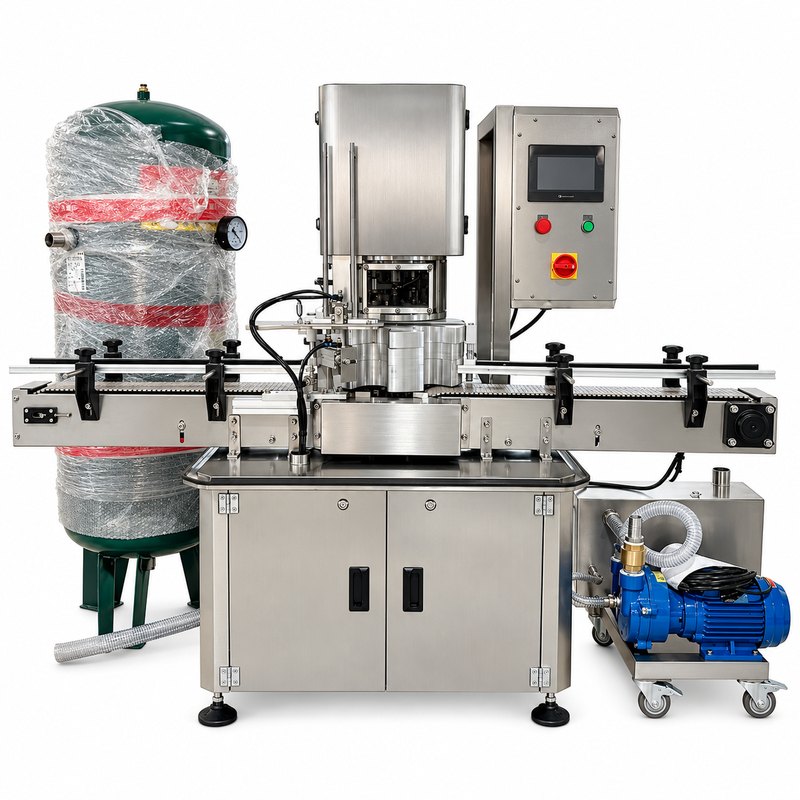
What It Is Built For vs. When to Choose Another Configuration
Use this rapid application screen to confirm whether LV-135ZFG Vacuum Can Seamer matches your container geometry, product flow behavior, and target throughput before freezing specifications.
Use It For
- Infant formula, nutritional powders, roasted coffee, premium nuts, and shelf-stable foods requiring residual-oxygen reduction via chamber vacuum before double seaming.
- Inline rigid can lines running 25–35 cans/min downstream of an auger powder filler or multihead combination weigher.
- Plants needing automated missing-lid alarms, no-lid/no-seam protection, and servo torque-monitored can-jam stops.
- 304 stainless steel washdown-friendly packaging rooms with AC 380 V power (~7 kW total) and ≥0.4 MPa (0.3 m³/min) compressed air.
When to Choose Another Configuration
- Your rigid container uses a threaded plastic or lug screw cap and induction foil liner rather than a rolled metal double seam.
→ Switch to Automatic Bottle Filling, Capping & Labeling Line - You are packing dry powders into 1–30 g single-serve flexible stick packs.
→ Switch to LV-400BF / 680BF / 980BF Multi-Lane Stick Pack Machine - You want resealable flexible zipper pouches (W 90–210 mm) instead of rigid cans.
→ Switch to LV-210 Rotary Premade Pouch Line
Technical Specifications & Operating Conditions
Every value below is grounded in LINEVO's factory catalog for can-seamer-vacuum (LV-135ZFG), paired with exact arithmetic imperial conversions where millimeter, gram, kilogram, or liter units apply.
| Parameter | Metric Value | Imperial Equivalent | Operating Condition & Engineering Note |
|---|---|---|---|
| Seaming speed | 25–35 cans/min | — | Operating range. The rate depends on the can, the condition of the product and the fill level. |
| Seaming heads | 1 | — | Number of seaming heads in this configuration. |
| Seaming method | Double seam | — | Seaming method for this configuration. |
| Can format | Set to customer can samples | — | Can diameter, height and format tooling are defined with your can and lid samples. Review every format you run. |
| Total power | Approx. 7 kW | — | Total installed power for this configuration. |
| Power supply | AC 380 V, 50 Hz | — | Electrical supply for this configuration. We specify voltage, phase and frequency to match your installation in the quotation. |
| Compressed air | ≥0.4 MPa | — | Compressed-air requirement at the machine. Confirm the supply available at your site. |
| Air consumption | Approx. 0.3 m³/min | — | Compressed-air requirement at the machine. Confirm the supply available at your site. |
| Vacuum buffer tank | 100–200 L | 26.4–52.8 US gal | Equipped with one water-ring vacuum pump. The tank size for your line is confirmed in the quotation. |
| Machine weight | Approx. 650 kg | Approx. 1,433 lb | Confirm whether the listed weight includes the vacuum pump and buffer tank when defining shipping weight and crate size. |
| Machine dimensions | 2000 × 1000 × 1750 mm | 78.7 × 39.4 × 68.9 in | Length × width × height. Review whether the dimensions include the separate vacuum pump and buffer tank; the layout drawing defines the complete floor space. |
| Frame and doors | 304 stainless steel | — | Machine construction; the worktop is carbon steel clad in 304 stainless steel. |
| Indexing table material | Food-grade polymer or stainless steel | — | Two listed options; the material is chosen in the quotation. |
What Is Included vs. What We Review Per Project
Clear scope boundaries prevent startup surprises between the base machine and project-specific dosing, tooling, and plant interfaces:
Included in Core Machine Scope
- Through-conveyor, servo-driven indexing table (food-grade polymer or stainless steel), and 1 double-seaming head with chromium-steel rollers
- External water-ring vacuum pump and 100–200 L stainless steel vacuum buffer tank
- 304 stainless steel frame/doors (stainless-clad worktop), PLC & touchscreen with adjustable speed, missing-lid alarm, no-lid/no-seam interlock, can-jam stop, and one-button fault reset
Reviewed & Specified With Your Quotation
- Target chamber vacuum level for your specific powder/granule (so light powders are evacuated cleanly without puffing out of the can)
- Seaming chuck, 1st/2nd operation chromium-steel rollers, and starwheel guides machined to each exact customer can & lid sample
- Floor-plan placement of the separate water-ring vacuum pump and 100–200 L buffer tank, plus optional upstream filling machine and conveyor
Working Sequence & Shop-Floor Countermeasures
Step-by-Step Operating Cycle
- STEP 01Filled cans arriving on the stainless conveyor are captured by the servo-driven indexing starwheel and paired with a lid from the lid chute.
- STEP 02The missing-lid sensor verifies lid presence (triggering an alarm and inhibiting seaming if a lid is absent) before seating the can inside the enclosed vacuum chamber.
- STEP 03Supported by the 100–200 L vacuum buffer tank and water-ring pump, the chamber evacuates headspace air down to the agreed vacuum setpoint in milliseconds.
- STEP 04First- and second-operation chromium-steel seaming rollers form a tight mechanical double seam while under vacuum, then release the sealed can onto the discharge conveyor.
Real Production Floor Failure Modes & LINEVO Countermeasures
Countermeasure: Pairing the water-ring vacuum pump with a dedicated 100–200 L vacuum buffer tank stabilizes vacuum recovery between consecutive cans.
Countermeasure: Programmed missing-lid alarm and no-lid/no-seam PLC interlock halt the seaming cycle before rollers engage an uncovered can.
Countermeasure: Servo-driven indexing table features adjustable torque limits and automatic can-jam stop with one-button HMI reset once cleared.
Countermeasure: Hardened chromium-steel double-seaming rollers maintain consistent first- and second-operation seam hook geometry.
Countermeasure: Quotation layout drawings explicitly position the 2000 × 1000 × 1750 mm main seamer alongside the external water-ring pump and buffer tank.
Comparing Quotations? Check These 5 Things First
5-Point Buyer Quotation Audit
- Speed Test Conditions vs. Shift OEE: Confirm whether quoted bags/boxes per minute reflect dry-cycle empty-film speed or filled product at your exact target weight, and plan net shift output using a realistic 0.70–0.85 OEE factor.
- Dosing & Upstream/Downstream Handshake: Verify mechanical chute/conveyor transitions and PLC ready/interlock signals between scales, primary sealers, cartoners, and checkweighers.
- Utility Power & Clean Dry Air Split: Match electrical panel build to your exact factory voltage, phase, and frequency (e.g., 220 V single-phase vs. 380 V/480 V 3-phase, 50/60 Hz) and confirm regulated oil-free dry air MPa and m³/min.
- Format Tooling for Extra Pack Sizes: Identify which pack dimensions adjust via HMI/handwheels versus which require dedicated forming collars, rotary discs, sealing chucks, or carton molds.
- Pre-Shipment Sample & Film FAT Run: Ensure the contract specifies a Foshan Factory Acceptance Test running your physical product samples and printed laminate reels or cartons before balance shipment.
Pre-Dispatch Foshan FAT & Project Sequence
Bench check of your product flow, piece geometry, and film/carton tolerances in Foshan.
Signed station list, utility schedule, format tooling table, and 2D CAD floor layout.
In-house CNC machining, SUS304/316L fabrication, and PLC electrical assembly.
Live or multi-angle video acceptance run on your actual packaging material before crating.
Sea-worthy export cases, bilingual HMI recipes, spare wear kit, and remote/on-site commissioning.
Control Cabinet & Pneumatic Hardware BOM
Main programmable logic controller coordinating dosing, film/pouch indexing, and sealing interlocks.
Phase-angle timing feedback, cabinet switching relays, and regulated 24V DC power supply.
Multi-recipe color operator terminal and inverter motor speed control for main drives and conveyors.
Actuation cylinders, pneumatic manifold valves, vacuum manometer, and air preparation unit.
Representative electrical, sensing, and pneumatic hardware fitted on LINEVO packaging configurations; exact part series or project-specified alternatives are itemized in your written quotation BOM.
Frequently Asked Questions
Does the 2000 × 1000 × 1750 mm dimension include the vacuum pump and 100–200 L buffer tank?
Review the quotation layout drawing carefully: 2000 × 1000 × 1750 mm (~650 kg) represents the main LV-135ZFG seamer unit, while the external water-ring vacuum pump and 100–200 L buffer tank sit adjacent and are mapped on your project DWG.
Can one LV-135ZFG run different can diameters and heights?
Each can height can be adjusted within stroke limits, while different can diameters or lid curl profiles require dedicated seaming chucks, rollers, and indexing starwheel guides built from your physical can and lid samples.
What plant utilities are needed to run the LV-135ZFG?
Total installed electrical power is approximately 7 kW (standard AC 380 V, 50 Hz; matched to local site 3-phase voltage in the quotation), compressed air ≥0.4 MPa at approx. 0.3 m³/min, and water supply/recirculation for the water-ring vacuum pump.
Should we pick the polymer or stainless-steel indexing table?
Food-grade polymer starwheels prevent scuffing on lithographed tinplate and paperboard composite cans, whereas stainless steel indexing tables suit heavy washdown or abrasive metal cans; choose in the quotation.