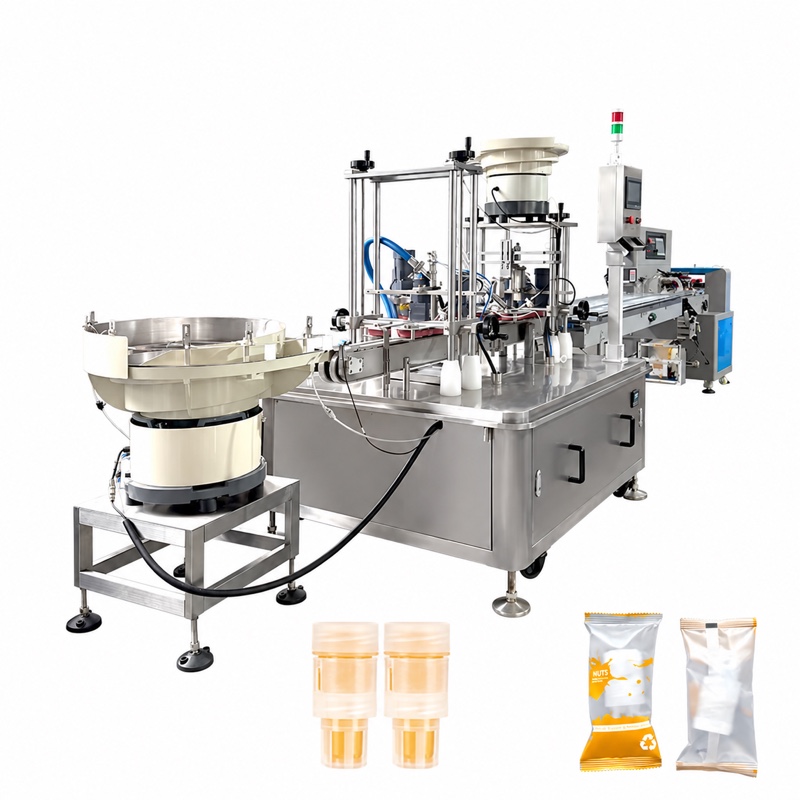
What It Is Built For vs. When to Choose Another Configuration
Use this rapid application screen to confirm whether Cap-Cavity Filling & Foil Sealing Line matches your container geometry, product flow behavior, and target throughput before freezing specifications.
Use It For
- Dosing pure honey, viscous syrups, herbal concentrates, or functional liquid shots directly into small cap cavities and spoon closures.
- Dual-compartment functional beverage brands where dry or liquid actives stay sealed inside the cap until the consumer twists or pushes.
- Nutraceutical and convenience food plants needing clean sealing rims free of honey tailing ahead of thermal foil lamination.
- Multi-SKU closure lines requiring tool-less modular pucks/holders to switch rapidly between cap geometries.
When to Choose Another Configuration
- You are filling standard 100 mL–5 L bottles or wide-mouth jars rather than miniature closure cavities.
→ Switch to Automatic Bottle Filling, Capping & Labeling Line - You are portioning dry powders or granules (1–30 g) into flexible single-serve stick packs.
→ Switch to LV-400BF / 680BF / 980BF Multi-Lane Stick Pack Machine - You need rigid tinplate or composite cans vacuum-sealed with a metal double seam.
→ Switch to LV-135ZFG Automatic Vacuum Can Seamer
Technical Specifications & Operating Conditions
Every value below is grounded in LINEVO's factory catalog for honey-cap-filling, paired with exact arithmetic imperial conversions where millimeter, gram, kilogram, or liter units apply.
| Parameter | Metric Value | Imperial Equivalent | Operating Condition & Engineering Note |
|---|---|---|---|
| Container format | Cap cavities, spoon caps and functional closures | — | Format compatibility is reviewed with actual drawings and samples. |
| Sealing process | Thermal foil sealing | — | Match the closure rim, foil or peelable film and sealing conditions. |
| Dosing options | Servo volumetric piston or peristaltic pump | — | Alternative dosing arrangements; select the pump through application review. |
What Is Included vs. What We Review Per Project
Clear scope boundaries prevent startup surprises between the base machine and project-specific dosing, tooling, and plant interfaces:
Included in Core Machine Scope
- Servo-driven volumetric piston or peristaltic closure dosing module (selected via viscosity review)
- Thermal foil rim-sealing station matched to closure cavity geometry
- Tool-less modular quick-change format fixtures for switching closure styles
Reviewed & Specified With Your Quotation
- Automated cap orientation/feeding bowl, dosing nozzle anti-drip cutoff, and peelable vs. weld foil specification
- Closure puck/carrier tooling machined to your 3D cap drawing and physical samples
- Downstream seal inspection, batch coding, and outersecondary packaging
Working Sequence & Shop-Floor Countermeasures
Step-by-Step Operating Cycle
- STEP 01Functional closures, spoon caps, or push-pull cavities are oriented into modular transport fixtures and indexed beneath the dosing head.
- STEP 02A servo-driven volumetric piston (for high-viscosity honey) or peristaltic pump (for shear-sensitive concentrates) meters the exact gram/milliliter dose cleanly into the cavity.
- STEP 03Foil lidstock or pre-cut peelable foil membranes are positioned over the clean closure rim and thermally bonded under controlled temperature and pressure.
- STEP 04Sealed functional caps advance to inspection, batch coding, and outer packaging or bottle assembly.
Real Production Floor Failure Modes & LINEVO Countermeasures
Countermeasure: Servo volumetric piston or peristaltic dosing with application-tested anti-drip nozzle cutoff keeps the tiny sealing land clean prior to foil contact.
Countermeasure: Custom closure tooling holds irregular cap skirts level through filling and thermal foil sealing, with tool-less quick-change swaps between SKUs.
Countermeasure: Thermal foil sealing dwell, head pressure, and foil lacquer chemistry are matched directly against your physical closure plastic (PP/PE/PET) in sample trials.
Countermeasure: Sanitary piston cylinder or disposable-tubing peristaltic pump options simplify CIP/washdown turnaround between batches.
Comparing Quotations? Check These 5 Things First
5-Point Buyer Quotation Audit
- Speed Test Conditions vs. Shift OEE: Confirm whether quoted bags/boxes per minute reflect dry-cycle empty-film speed or filled product at your exact target weight, and plan net shift output using a realistic 0.70–0.85 OEE factor.
- Dosing & Upstream/Downstream Handshake: Verify mechanical chute/conveyor transitions and PLC ready/interlock signals between scales, primary sealers, cartoners, and checkweighers.
- Utility Power & Clean Dry Air Split: Match electrical panel build to your exact factory voltage, phase, and frequency (e.g., 220 V single-phase vs. 380 V/480 V 3-phase, 50/60 Hz) and confirm regulated oil-free dry air MPa and m³/min.
- Format Tooling for Extra Pack Sizes: Identify which pack dimensions adjust via HMI/handwheels versus which require dedicated forming collars, rotary discs, sealing chucks, or carton molds.
- Pre-Shipment Sample & Film FAT Run: Ensure the contract specifies a Foshan Factory Acceptance Test running your physical product samples and printed laminate reels or cartons before balance shipment.
Pre-Dispatch Foshan FAT & Project Sequence
Bench check of your product flow, piece geometry, and film/carton tolerances in Foshan.
Signed station list, utility schedule, format tooling table, and 2D CAD floor layout.
In-house CNC machining, SUS304/316L fabrication, and PLC electrical assembly.
Live or multi-angle video acceptance run on your actual packaging material before crating.
Sea-worthy export cases, bilingual HMI recipes, spare wear kit, and remote/on-site commissioning.
Control Cabinet & Pneumatic Hardware BOM
Main programmable logic controller coordinating dosing, film/pouch indexing, and sealing interlocks.
Phase-angle timing feedback, cabinet switching relays, and regulated 24V DC power supply.
Multi-recipe color operator terminal and inverter motor speed control for main drives and conveyors.
Actuation cylinders, pneumatic manifold valves, vacuum manometer, and air preparation unit.
Representative electrical, sensing, and pneumatic hardware fitted on LINEVO packaging configurations; exact part series or project-specified alternatives are itemized in your written quotation BOM.
Frequently Asked Questions
How do we choose between a servo volumetric piston pump and a peristaltic pump?
High-viscosity pure honey and thick syrups generally require positive-displacement servo volumetric pistons for crisp cutoff, whereas lower-viscosity functional shots and shear-sensitive extracts suit peristaltic tubing pumps for rapid tube-swap sanitation.
What samples are required before freezing the cap-cavity line scope?
LINEVO requests 2D/3D closure drawings, physical cap samples, target fill weight in grams, foil/film material specs, and 2–5 kg of your actual honey or concentrate to validate rim cleanliness and thermal foil bond strength.
Can one machine run both spoon caps and push-pull beverage caps?
Yes, provided both formats fall within the station pitch—modular quick-change carrier fixtures swap without hand tools to accommodate multiple closure geometries.